
The Rider
A chapter from Syntropy Domain — Book I
This is a chapter from Architect of Reality, the opening novel of the Syntropy Domain trilogy.
Death rides a motorcycle. A man doesn’t realize he’s dead until he’s already been riding alongside it for a while.
Everything you need to know about this universe starts here.
The road stretches ahead.
The man rides his bike.
The asphalt hums beneath the tires. The engine settles into a rhythm he no longer thinks about. Wind meets his chest and stays there. The sky begins to lose color steadily, as though something behind it were being turned down.
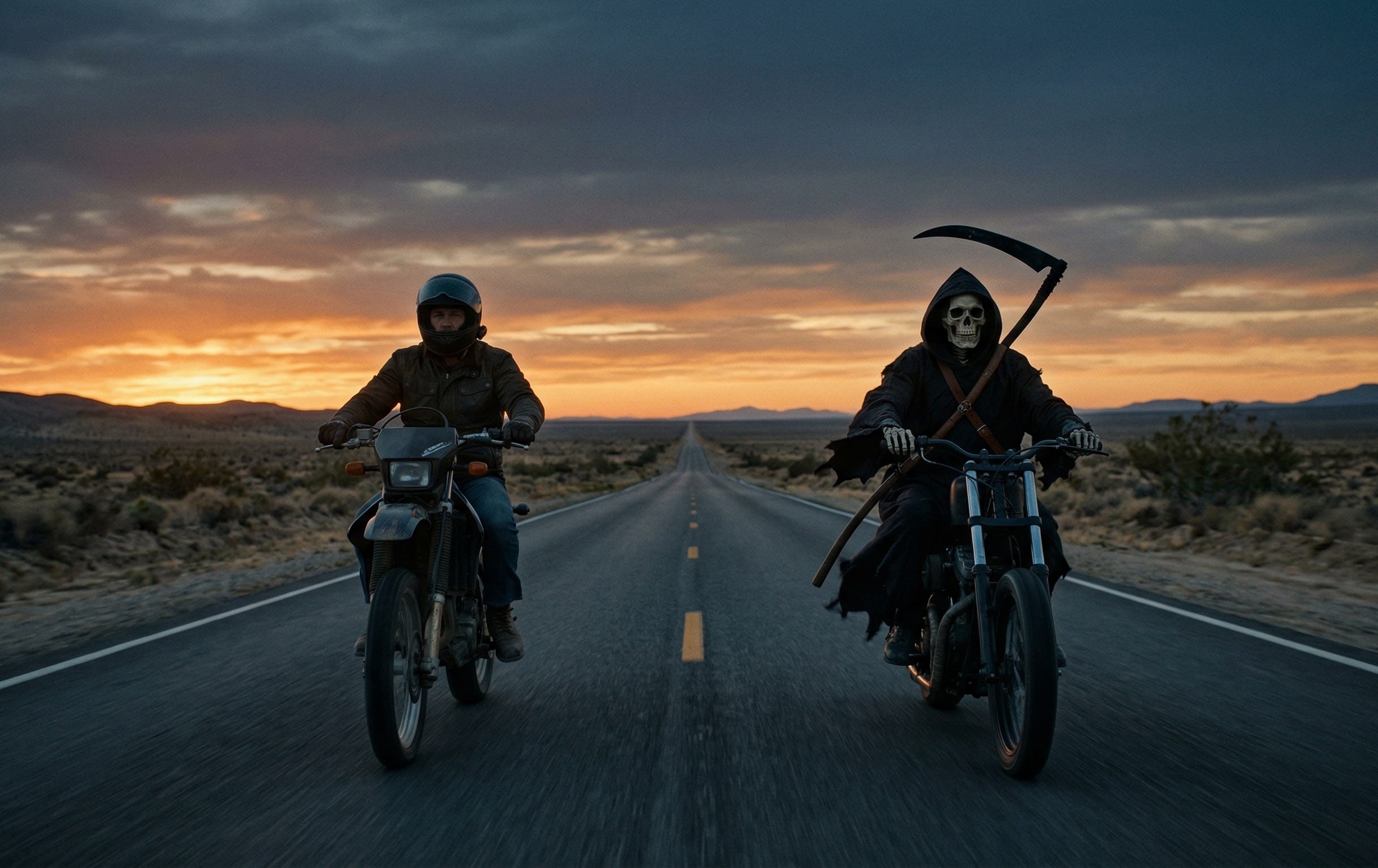
He has been riding for a while before he notices the second engine. Not the sound—he hears that immediately—but the fact that it has matched him. The presence settles alongside his own, unhurried.
He looks left.
The motorcycle beside him is larger than his. Built for distance. Metal frame. No exhaust. No vibration. It holds its pace without effort, as if the road belonged to it.
At the handlebars sits a skeleton.
The robe moves with the wind. The hood does not hide much. A scythe is strapped across its back, secured the way tools are secured when they are meant to be used again.
The rider blinks. The road continues. He keeps riding.
For a time, neither of them speaks. The engines fill the space. The wind does the rest.
“Wow,” he says. “Nice bike.”
“Thank you,” the skeleton replies. “It’s easier on the hips than a horse.”
The rider exhales, surprised to hear himself laugh. The sound leaves him and does not come back.
Then something catches.
“…Wait.”
Nothing changes. The wind meets him where it always has.
He looks ahead. And back.
“Oh.” A pause, long enough to matter. “Oh. Right.”
The skeleton turns its skull, enough to indicate attention.
“When did it happen?” the rider asks.
“Do you remember the armadillo?” the skeleton says. “The one you swerved for.”
The man nods. He remembers the decision more than the animal. A correction made too late.
“Yes.”
“You missed.”
Silence returns. The wind claims it.
The rider lets that settle. He waits for a surge—for fear, or anger, or some form of protest. He waits for his body to argue.
Nothing comes.
“Oh,” he says.
“Yes.”
“And now?”
“Now we ride,” the skeleton says. “For as long as you want.”
They do.
The horizon dims. The sky continues its work. He keeps riding, and the effort no longer feels like effort.
“That’s strange,” he says after a while. “I thought I’d feel more.”
“Chemistry,” the skeleton answers. “Without a body, it loses authority.”
He turns that over.
“That tracks.”
He asks about his body because it seems like the thing one is meant to ask about.
“Will it be found?”
“Raccoons,” the skeleton says. “Vultures, for sure.”
A pause.
“Does it matter?”
The man considers the question and is surprised by how quickly the answer arrives.
“No,” he says. “No, it doesn’t.”
The sun drops. The road darkens. Blue replaces orange. Then replaces itself. Time keeps moving. It has lost its grip.
The rider eases off the throttle.
He pulls over near a rise in the road. Gravel answers the tires. He cuts the engine and listens to the sudden absence.
The skeleton stops beside him.
The man puts his feet down. The habit remains.
“I think I’m ready,” he says. “To cross.”
“Good.”
The skeleton dismounts.
“Would you prefer the scythe,” it asks, “or my hand?”
The man smiles. The expression arrives before he decides to make it.
“The scythe,” he says. “If you don’t mind.”
“Of course.”
“Since the body will be eaten,” he adds, “it feels right that this part stays solemn.”
“That’s reasonable.”
The skeleton removes the scythe and raises it.
Moonlight finds the blade. Light runs along its edge and slips away.
One motion.
There is no pain. No resistance. Nothing to push against.
Something detaches from the man. A thin flame, yellow, steady. The skeleton holds it as carefully as anything else it carries.
It gestures behind him.
“There,” it says. “Your threshold.”
He turns.
A doorway stands in the road. Light without sound. It waits.
“What’s on the other side?” he asks.
“You know,” the skeleton says. “You cross. I don’t.”
The rider looks at the light. He looks back.
“It was good riding with you,” the skeleton says. “Andrew.”
“That was something,” he says. “Thank you.”
He steps forward.
The light closes without ceremony.
The road empties.
The skeleton rests one hand on the handlebar and looks toward the horizon, now fully dark.
“Not many left,” it says, “who still recognize the touch of the scythe.”
The engine starts.
The road remains.